Maker and taker fees need execution evidence
Separate order intention, actual execution role, fee asset and effective tier from an assumed low-cost strategy result.
Order type is an intention, not a fee receipt
A submitted limit order is not by itself proof of maker execution. The selected venue's matching and time-in-force rules matter, and an order may not execute. A post-only instruction has its own documented acceptance/cancellation contract rather than a guaranteed profitable fill. Record actual execution identity, role, quantity and fee cash for genuine results. The teaching packets have no real orders or roles. Their entered basis points are assumptions, not a measured venue tier, rebate entitlement or paid-account experience. Do not paste current advertised rates into historical results without the effective source.
The fee base changes with the object
The original budget deliberately applies fee basis points to fixed initial notional. The new linear lens keeps reference quantity fixed, so an exit price change also changes its exit fee base. Inverse fees use coin-valued bases under the declared equation. Actual accounts may need different asset conversion and rounding rules, which this tool does not implement. Fee asset and settlement asset cannot be assumed equivalent just because an interface displays both with a familiar currency sign. Keep authentic cash and reporting conversion outside the assumed component calculation.
Partial execution creates a population question
One request can lead to multiple unique executions, incomplete quantity and a later cancelled remainder. Fees must follow actual fill quantities and roles, not the desired order total. Repeated order-state notifications are not additional executions. A reviewer needs a complete unique fill population and query scope to avoid double counting. The paper drill separates partial position from unfilled remainder but invents no actual fee. It is not an exchange simulator or a recovered account. Historical roles and tariffs remain absent until their genuine records are supplied.
Cost sensitivity is not tariff validation
A hypothetical rate can expose whether a small assumed price move survives a chosen cost, but it cannot establish what a real user paid. Keep slippage, funding and subscription inclusions named separately. A stronger comparison needs the same eligible exposure, period and valuation basis. It also needs actual selected terms and instrument permissions. Software tests verify valid and invalid numerical inputs without becoming customer review samples. No maker probability, average price improvement or universal platform winner is calculated from these examples or inferred from an official feature description.
Fictional crypto evidence case
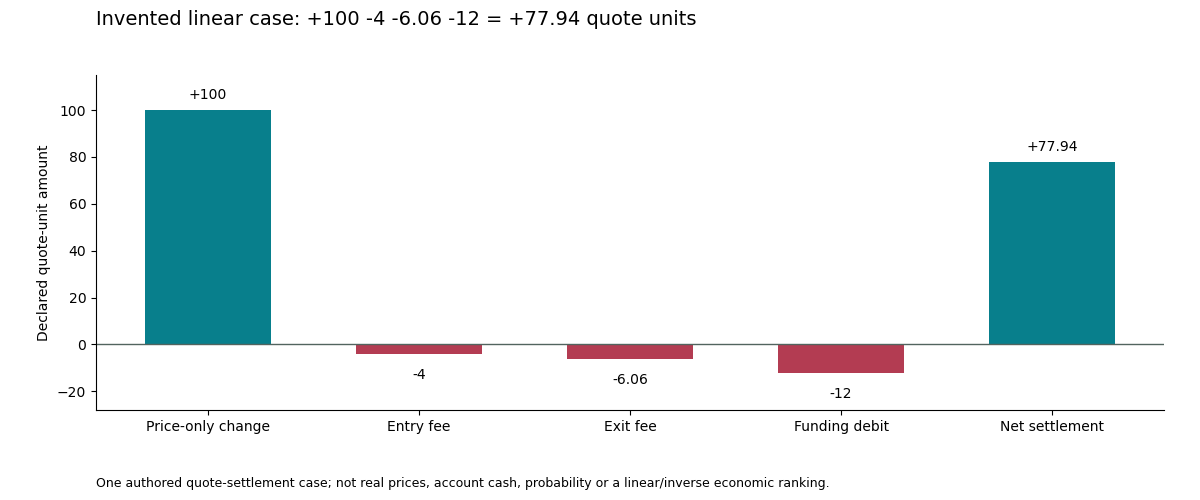
The invented matched comparison has 100 quote gross, entry fee four and funding debit twelve. Fixed-notional exit fee six gives net 78. The new fixed-reference linear exit value 10,100 gives fee 6.06 and net 77.94. The 0.06 difference identifies a declared fee base; it says nothing about actual maker/taker status or a better venue.
| Object | Record | Bounded finding |
|---|---|---|
| Request | Limit intention | No role authenticated |
| Exit fee | 6 versus 6.06 assumed | Different basis |
| Actual fill | Absent | No tested tariff |
Primary references and scope
Source review: 14 October 2026. Official mechanism descriptions are not this desk's paid-account test, independently captured fills or vendor-return audit.