A Crypto Backtest Needs the Tokens That Disappeared
Define historical eligibility, listings, delistings and price availability before testing a strategy on today's surviving markets.
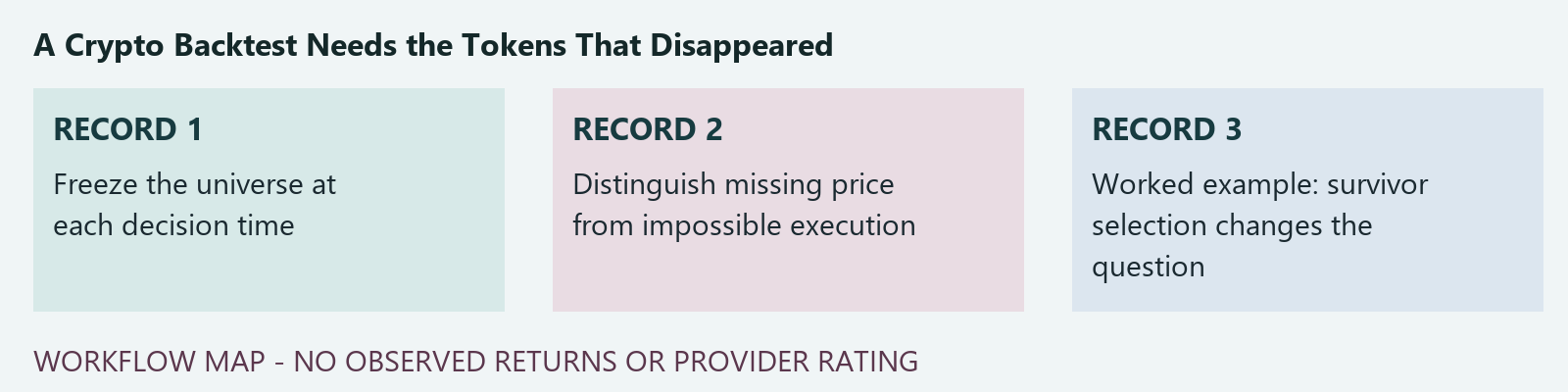
Freeze the universe at each decision time
Name venue, product type, eligibility rule and the date at which each market could enter the study. Today's list of liquid assets is not necessarily the list a historical trader could have selected. Preserve listing, suspension, delisting and symbol-mapping records. If those records are absent, narrow the research question rather than inventing a complete historical universe. A study of current survivors can still be described honestly, but it cannot silently become evidence about all markets available at the original start.
Distinguish missing price from impossible execution
A data gap, halted market, delisted product and inaccessible account are different states. Record the source reason where known. Forward-filling a stale quote can create an apparently tradable price when no execution evidence exists. Do not automatically classify every missing observation as a loss or delete it from the population. Define an explicit missing-case policy before evaluating results. The policy should identify when a research reference remains possible and when an account-execution claim is unsupported.
Worked example: survivor selection changes the question
Invent a universe with five markets at the start. By the review date, three remain listed and two have disappeared. Testing only the three current markets answers a survivor-sample question. Without the missing histories, it cannot establish the original five-market strategy outcome or its success rate. Do not assign plausible terminal losses to the missing markets merely to appear conservative; those would still be invented facts. Publish the missing identities, source requests and exact narrower question supported by the available observations.
Keep market and account units explicit
Separate spot holdings, perpetuals and dated derivatives. Record quantity convention, settlement, collateral, funding and fees under the actual venue specification. A token return series does not reconstruct the derivative account result. CFTC customer guidance provides risk context, not a historical dataset or provider endorsement. Contract and margin references explain general questions but cannot supply crypto venue-specific terms. Any hypothetical proxy needs an explicit research-reference label and must not masquerade as actual broker or exchange fills.
Protect the evaluation from later membership knowledge
Save the candidate search, historical admission rule and data availability alongside the time split. A chronological test can still leak future membership if the assets were selected because they survived or became liquid later. Cross-validation documentation defines evaluation mechanisms; the universe design remains your responsibility. Keep strategy selection and later evidence separate, with one declared execution or exit policy for the experiment. Do not restore independence by relabelling an already inspected period after a promising universe adjustment.
Report the coverage before the return
A research report should show requested markets, recovered records, gaps, eligibility dates and output states. Explain which conclusions depend on unavailable data and which mechanics were only checked on invented fixtures. This chapter is a universe-construction protocol, not a completed crypto strategy study. Its blank coverage sheet helps another researcher see the boundary of the sample before judging a performance chart. Honest scope is essential: a precise result from a selected survivor set remains a result about that set, not the entire historical opportunity population.
Decision record
| Question | Record to retain | Decision boundary |
|---|---|---|
| Membership | Historical admission, closure and mapping records | Current survivors are not the original universe |
| Availability | Gap reason and explicit missing-case policy | Stale filled prices are not execution evidence |
| Product | Venue, settlement and quantity convention | Token moves do not reconstruct every account type |
| Evaluation | Membership rule and selection access history | Time splitting cannot repair hindsight membership |
Blank working record
The worksheet contains column headings only. Enter your own dated observations, keep absent evidence marked unknown, and do not treat the file as certification.
 Download worksheet (CSV)
Primary references
- scikit-learn: cross-validation and temporal data
- CFTC: AI trading claims
- CME: performance bonds and margin
These documents support mechanisms and source definitions, not a tested trading result or a recommendation. Accessed 9 October 2026. The decision workflow and invented examples above are editorial exercises.
Keep reading
Publication methodology | Working glossary | Source and correction policy
Membership includes contract and token versions
A current symbol list can describe today's instrument metadata without telling when a market was selectable in the past. Keep venue, product category, effective listing/delisting interval and token/network migration relation together. Distinguish missing observation from a price of zero and preserve rights for historical data. The new migration and identity investigations attach narrow source questions, not a reconstructed archive. No vanished token series or economic outcome was fabricated. An actual historical population still needs independently verified eligible records before its strategy result can be accepted.